Assumed background
No coding experience and no advanced math are assumed. Basic arithmetic, careful reading, and access to a Python setup are enough to start.
A guided course from first program to real projects
A guided Python course with 28 chapters of concept lessons, worked traces, visual models, code/output projects, checkpoints, quizzes, and answer keys from first programs to data structures, OOP, exceptions, standard-library tools, concurrency, data work, and algorithms.
Secure checkout with Stripe. Your receipt gives you a private download link, and there is no subscription.
Python Craft is a complete beginner-friendly path into programming. It starts with the first print statement and builds through variables, expressions, strings, conditionals, loops, functions, lists, dictionaries, files, errors, modules, recursion, object-oriented programming, generators, decorators, concurrency, data work, NumPy, pandas, searching, sorting, and classic algorithms. The course treats Python as a language you learn by making behavior visible.
Best for: Learners who want Python to feel understandable from the first print statement through functions, data structures, objects, and algorithms.
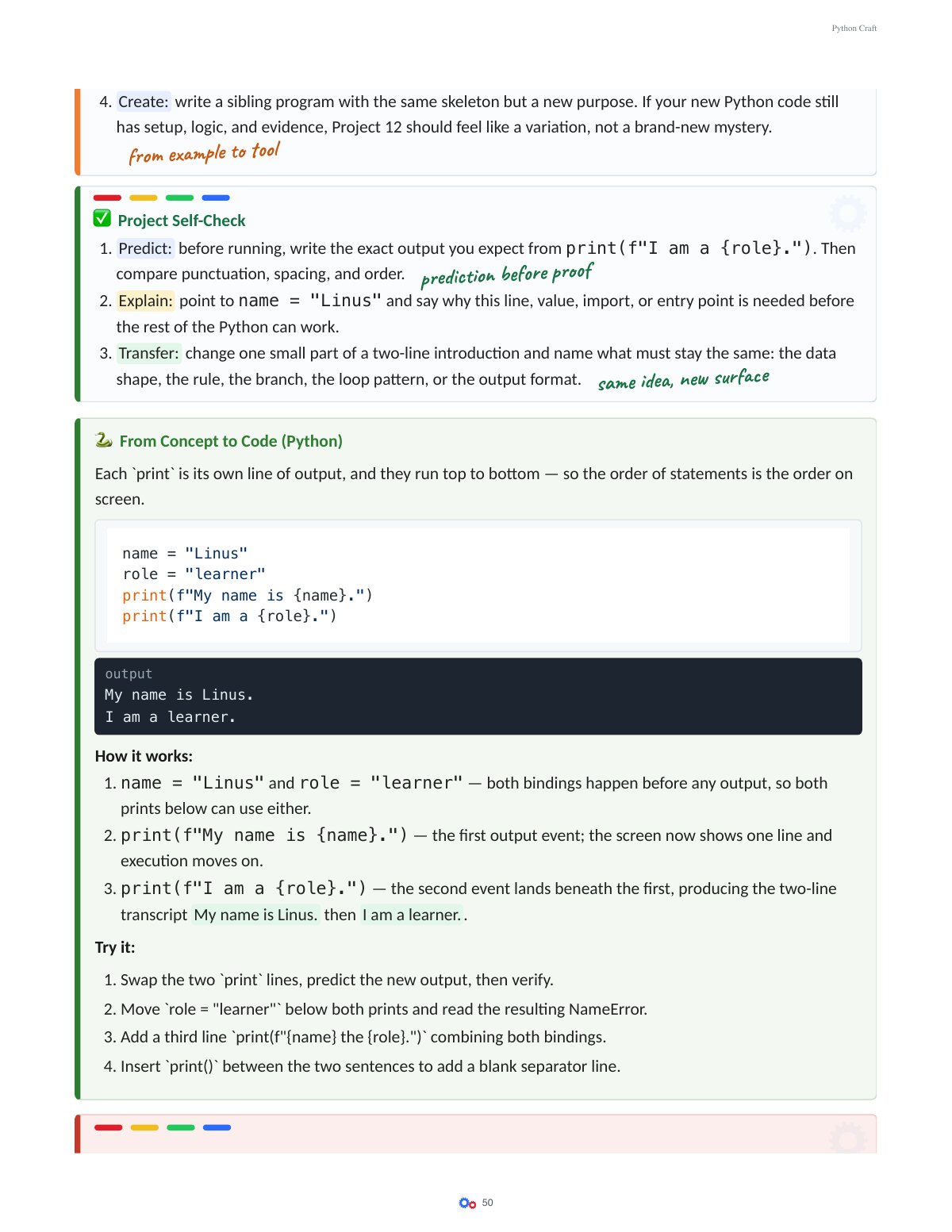
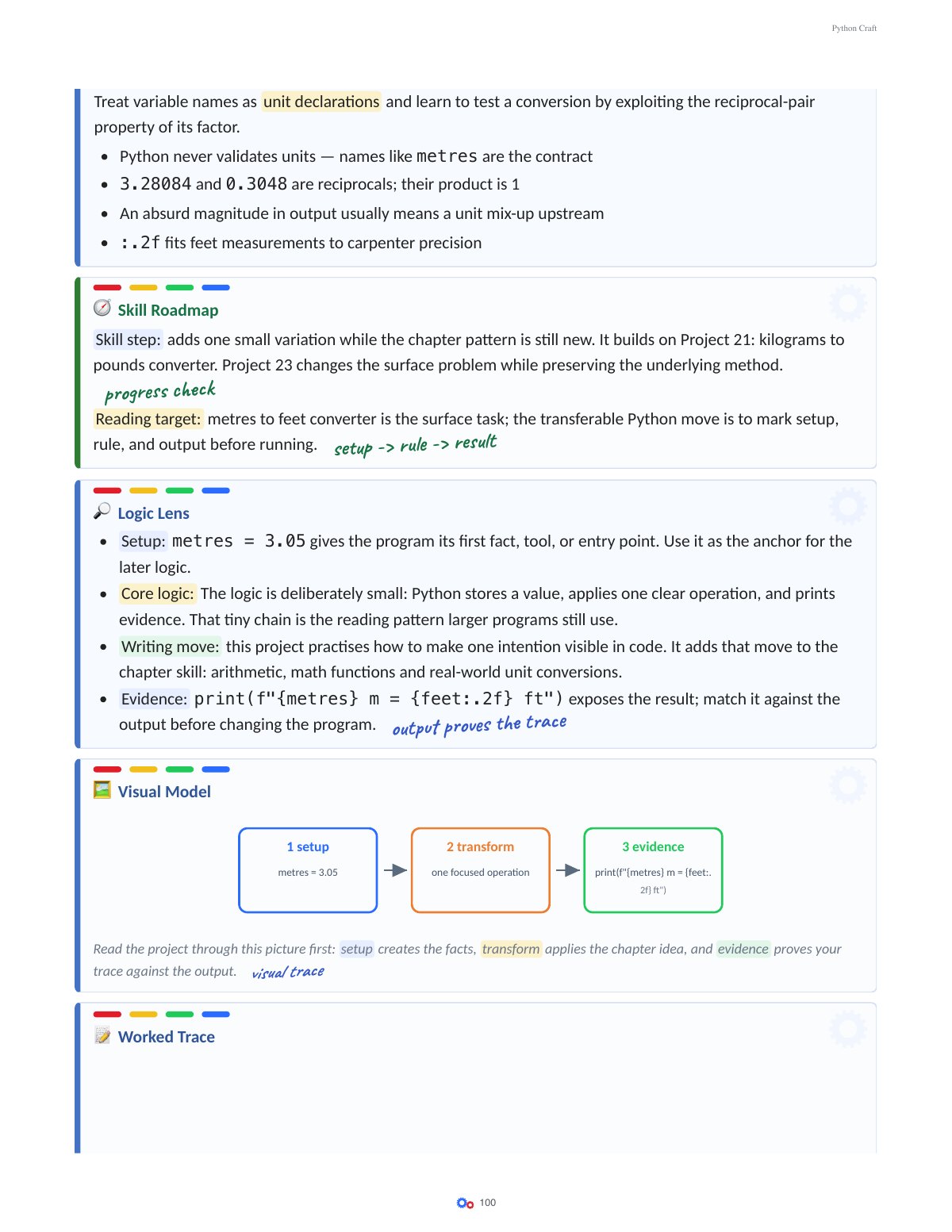
The book's method is to connect intention, code, and output. Each lesson begins with a small idea, turns it into runnable code, shows the exact result, and then explains why the result happened. Learners are not expected to already think like programmers. The book builds that thinking through prediction, tracing, naming, repair, and small variations that make cause and effect obvious.
The lesson explains the new programming idea in plain English before showing syntax.
Examples are complete enough to type, run, and inspect rather than disconnected fragments.
The result is shown so learners can compare their program against visible evidence.
Values, branches, loops, function calls, list changes, dictionary lookups, or object state are followed step by step.
Indentation, off-by-one loops, wrong types, missing returns, mutable data, and file/path issues are named directly.
Quizzes and exercises reinforce the habit before the next chapter adds complexity.
Five full pages from the PDF. Select a page to open it at full size.
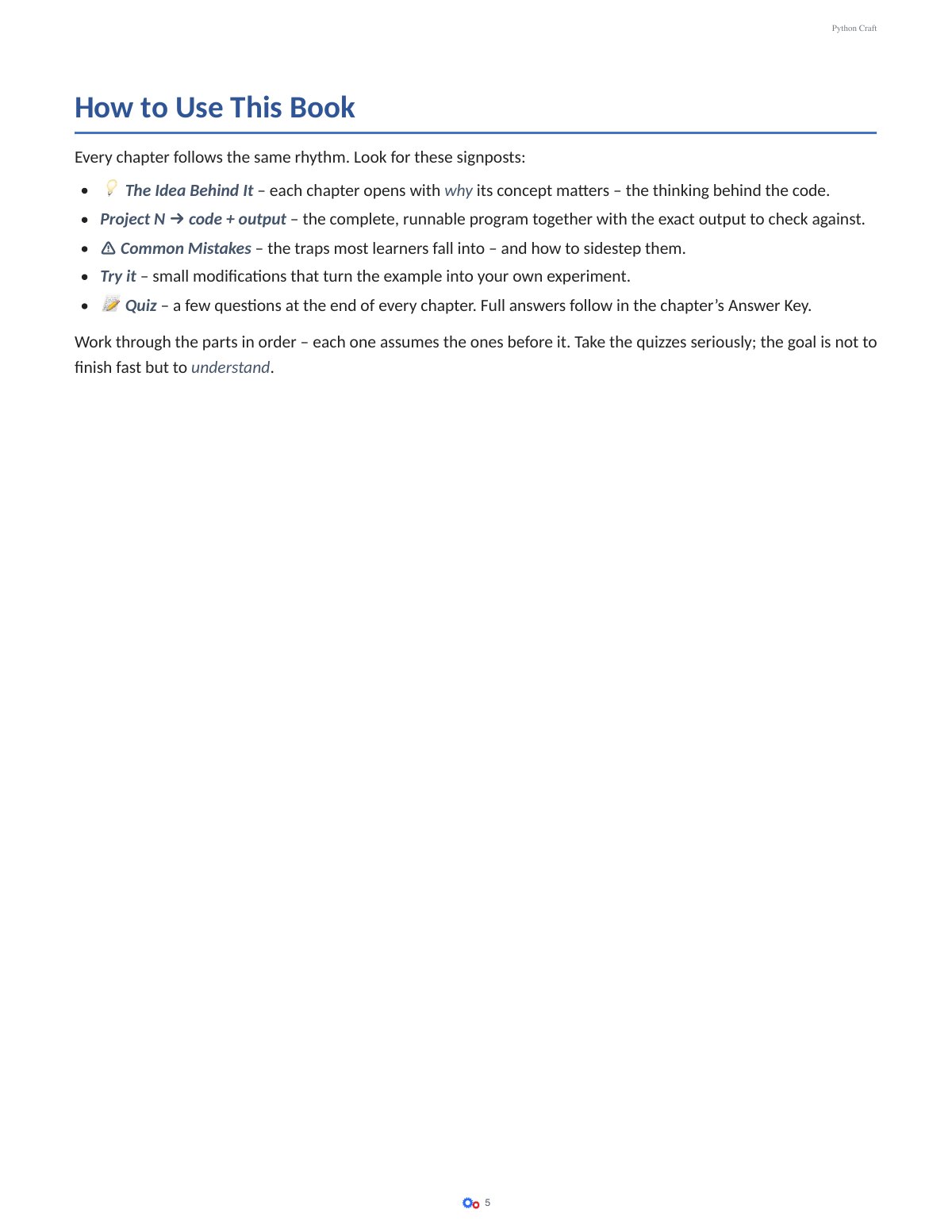
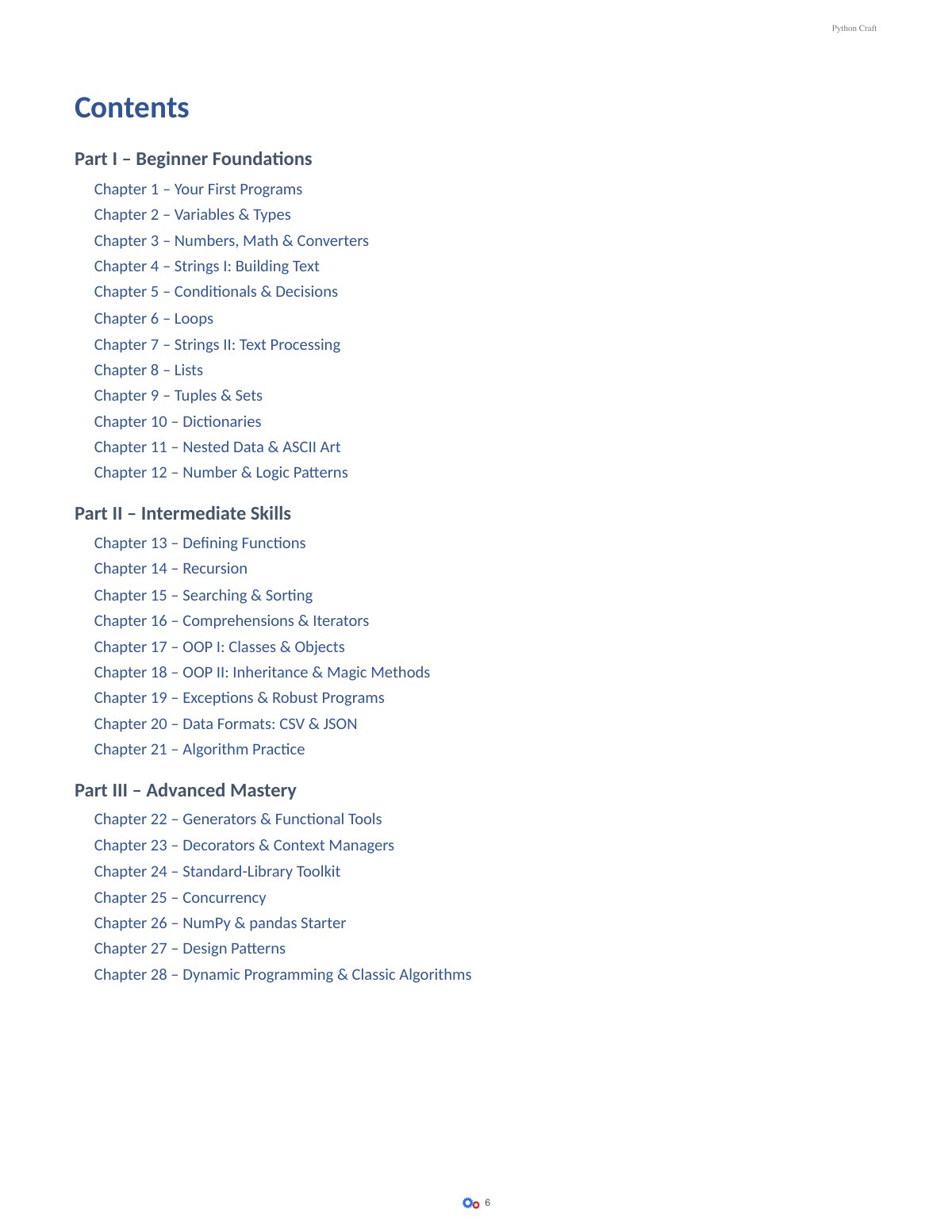
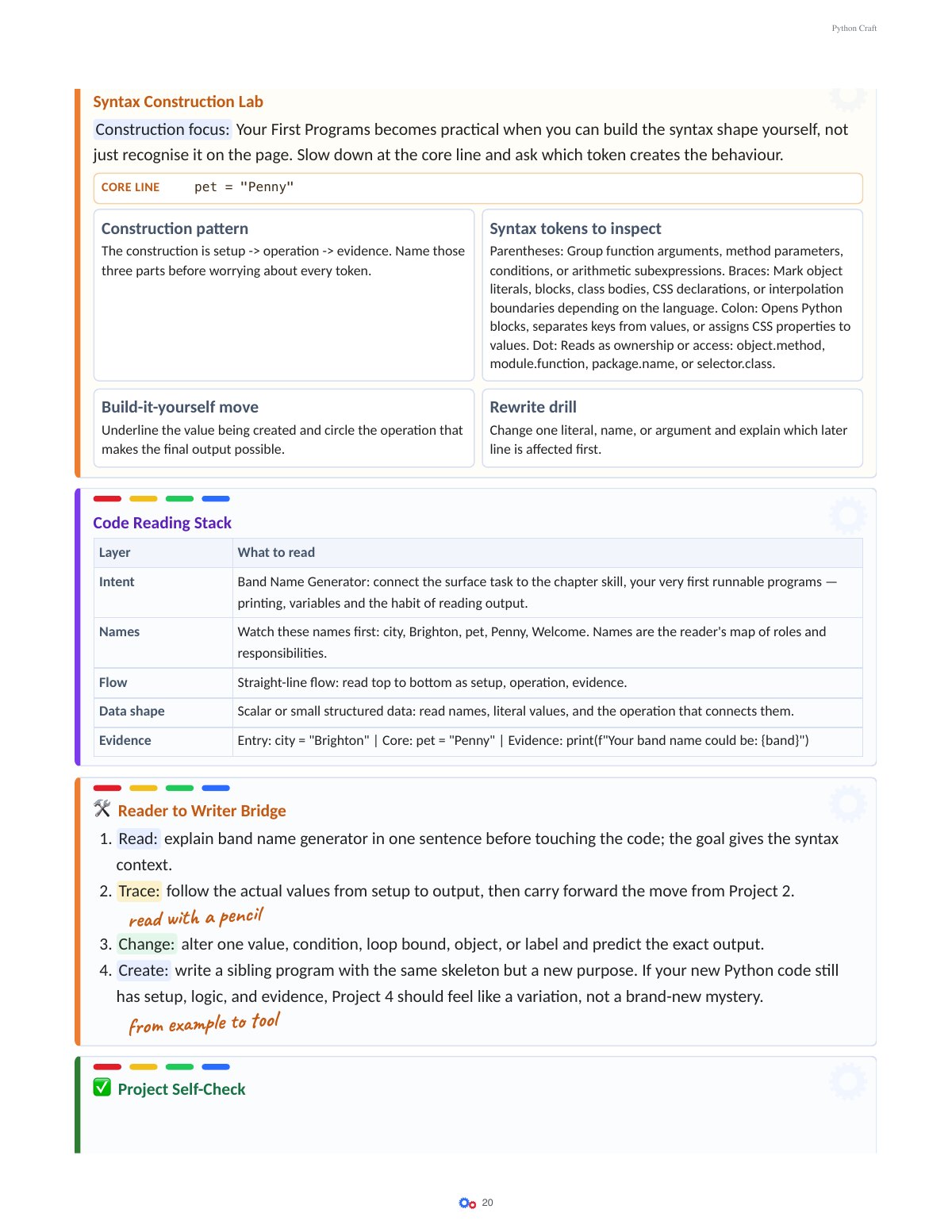
No coding experience and no advanced math are assumed. Basic arithmetic, careful reading, and access to a Python setup are enough to start.
A realistic first-programming pace is 10 to 14 weeks with regular practice. Faster readers can move through early syntax quickly, but beginners should type examples, run them, break them safely, and fix them. By the end, the reader should be able to build small Python programs, read unfamiliar code, handle data structures, use files and modules, and approach algorithms with a clear method.
See the purchase terms and privacy policy. Questions? support@indepapps.com
No coding experience and no advanced math are assumed. Basic arithmetic, careful reading, and access to a Python setup are enough to start. It is written for self-study and builds up step by step.
A realistic first-programming pace is 10 to 14 weeks with regular practice. Faster readers can move through early syntax quickly, but beginners should type examples, run them, break them safely, and fix them. By the end, the reader should be able to build small Python programs, read unfamiliar code, handle data structures, use files and modules, and approach algorithms with a clear method.
A 2,000-page PDF (34.3 MB). After payment, your receipt page gives you a private, single-use download link, and we email you a link to that receipt. Save the PDF after downloading.
It is a standard PDF for a computer, tablet or phone, online or offline. It is a one-time purchase of $25 with no subscription. You keep the file for your own reading; the purchase terms explain the personal-use licence.
If a transfer is interrupted, the link is released so you can try again from your receipt. If it still fails, email support@indepapps.com with your order number instead of buying again.
A complete Java course built around executed projects, exact output, traceable reasoning, and practical programming habits.
$25 · PDF
Sixteen chapters and 209 runnable projects, from NumPy and pandas to scikit-learn, PyTorch, transformers, RAG and MLOps.
$25 · PDF
A large source-backed programming resource edition with project cards, logic exercises, code/output layouts, and cited source paths.
$25 · PDF